Instagram SEO: How to Get Found in Search (Not Just the Feed)
Instagram has its own search engine, and since July 2025 Google indexes a slice of public posts too. Here's where your keywords actually matter.
 Insta Saver TeamJune 24, 20269 min read
There is no single Instagram algorithm, and most "hacks" you have read do nothing. Here is what actually decides your reach in 2026 — and what you can do about it.
 Insta Saver TeamJune 24, 20269 min read
You post something you're proud of, and it barely moves. A week later a throwaway clip does three times the numbers. It feels random — and when reach feels random, it's tempting to reach for a hack. Most hacks do nothing. This post walks through what actually decides who sees your posts in 2026, which signals you can influence, and which popular advice is just noise.
We'll keep it honest: no invented percentages, no promises of viral growth, and a clear line between what Instagram has confirmed and what's an educated read of how the app behaves as of 2026.
The first thing to unlearn: Instagram doesn't run one master algorithm that ranks everything. It runs several different ranking systems, one for each surface — Feed, Stories, Reels, Explore, and Search. Each was built for a different reason and weighs things differently.
That matters because advice that works for one surface can be useless on another. "Post when your audience is online" helps in Feed and Stories, where recency counts. It matters far less on Reels and Explore, where Instagram is mostly deciding whether to show your video to people who *don't* follow you — often days after you posted.
Instagram's own head, Adam Mosseri, has said this plainly more than once: they use different ranking for different parts of the app because people use those parts for different reasons. You open Stories to keep up with people you already know, so those systems lean on relationship and recency. You scroll Reels to be entertained by anything good, so that system leans on whether the video holds attention — regardless of who made it. Keep that framing and most decisions get simpler.
Recency and your relationship with each viewer matter most. This is where consistency and replies pay off.
A discovery engine. Watch time and whether strangers engage decide how far it travels — timing matters little.
Keywords in your handle, name, captions, and alt text help you show up. Slow, but evergreen.
Across those surfaces, a handful of signals do most of the work. Instagram has talked about these publicly, and they line up with what creators see. They're less like a scoreboard and more like a series of predictions: for each post and each person, the systems guess how likely that person is to care, then rank accordingly. Roughly in order of how much they move reach:
One of the most useful things to understand is *when* your reach arrives — because it's completely different depending on the surface. A Feed post or Story front-loads: most of the people who'll ever see it do so in the first day, then it fades. A Reel is the opposite. It can trickle for a day or two, then climb as Instagram tests it with more non-followers, sometimes peaking well after you'd written it off.
That single difference explains a lot of confusing advice. 'Delete it if it flops in an hour' comes from Feed thinking, where the early hours really are most of the story. Apply that to a Reel and you'll delete videos right before they were about to take off.
The practical takeaway: judge a Feed post within a day, but give a Reel a week before you decide it didn't work. And when you look at your own Insights, note the *shape* of the curve, not just the final number — it tells you which system did the work.
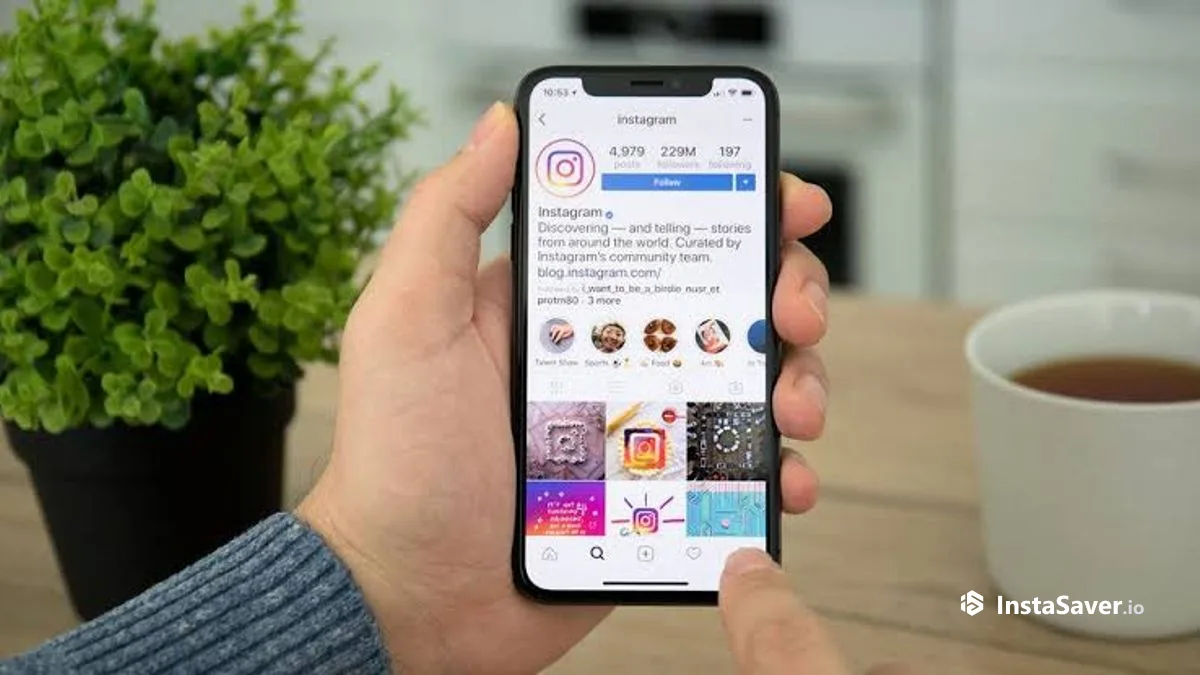
Open almost any large account and you can see the systems working together. A profile like Instagram's own shows the mix: a following count that seeds who sees new posts first, a grid of Reels and carousels made to travel beyond followers, and a bio full of searchable words.
A lot of reach advice is either outdated or was never true. Here are the ones that waste the most time.
| You may have heard… | What's actually true (as of 2026) |
|---|---|
| "There's a shadowban and it killed my reach." | Reach dips are almost always format, timing, or a quiet drop in engagement — not a secret ban. Guideline violations can limit you, and Instagram now tells you when that happens in Account Status. |
| "Post at exactly 9am for the algorithm." | Your audience's active hours help in Feed/Stories, but there's no universal magic time. It barely matters on Reels. |
| "Delete and repost if it flops in the first hour." | The first hour isn't a make-or-break test, especially for Reels, which keep getting served for weeks. Deleting mostly loses the reach you already earned. |
| "Hashtags are dead" / "use 30 hashtags." | Hashtags are minor now — a few relevant ones help categorisation. Keywords in your caption and handle do more for Search. |
| "Engagement pods trick the system." | Engagement from people with no real interest sends a weak signal and can look inorganic. It doesn't build the relationship or watch-time signals that matter. |
None of this requires tricks. It requires making things a specific group of people want to engage with, then giving the systems clear signals. A simple, honest playbook:
Trying to master Feed, Stories, and Reels at once spreads you thin. Choose the one that fits your content and audience, and go deep.
For Reels, earn the first two seconds and the loop. For carousels and posts, make it worth saving. Watch time and saves are the signals that travel.
Reply to comments and DMs, use Stories to talk to the people who already follow you. Strong relationships lift everything else you post.
Some things are simply out of your hands, and chasing them wastes energy. You can't control the exact moment Instagram decides to test your Reel with new viewers, how many people happen to be online when you post, or whether a bigger account covers the same topic that day. You also can't control the baseline interest in your niche — some topics are just searched and shared more than others.
That's fine, because the levers that *do* move — making something worth finishing or saving, and staying consistent enough that Instagram has recent signals to work with — are the ones you own completely. Focus there and the uncontrollable parts average out over dozens of posts. One post's reach is noisy; the trend across a month is the honest signal.
If your reach recently fell off a cliff, the cause is usually one of a handful of real, fixable things — not a ban. We break those down in why your Instagram reach dropped. And before you chase whatever's trending, it's worth knowing which Instagram trends are worth your time and which quietly cost you more than they return.
Want to look closely at the posts and profiles doing well in your niche? Insta Saver's free tools let you view and save public Instagram content to learn from — right in your browser.
We build free Instagram tools — an anonymous story viewer plus photo, video, reels, and profile downloaders — and write practical guides on saving, viewing, and understanding Instagram content, without the hype.
More about usInstagram has its own search engine, and since July 2025 Google indexes a slice of public posts too. Here's where your keywords actually matter.
Instagram capped hashtags at five and quietly killed hashtag-follow. Here is what that actually means, and what to use instead for the reach hashtags used to promise.