Instagram SEO: How to Get Found in Search (Not Just the Feed)
Instagram has its own search engine, and since July 2025 Google indexes a slice of public posts too. Here's where your keywords actually matter.
 Insta Saver TeamMay 28, 20268 min read
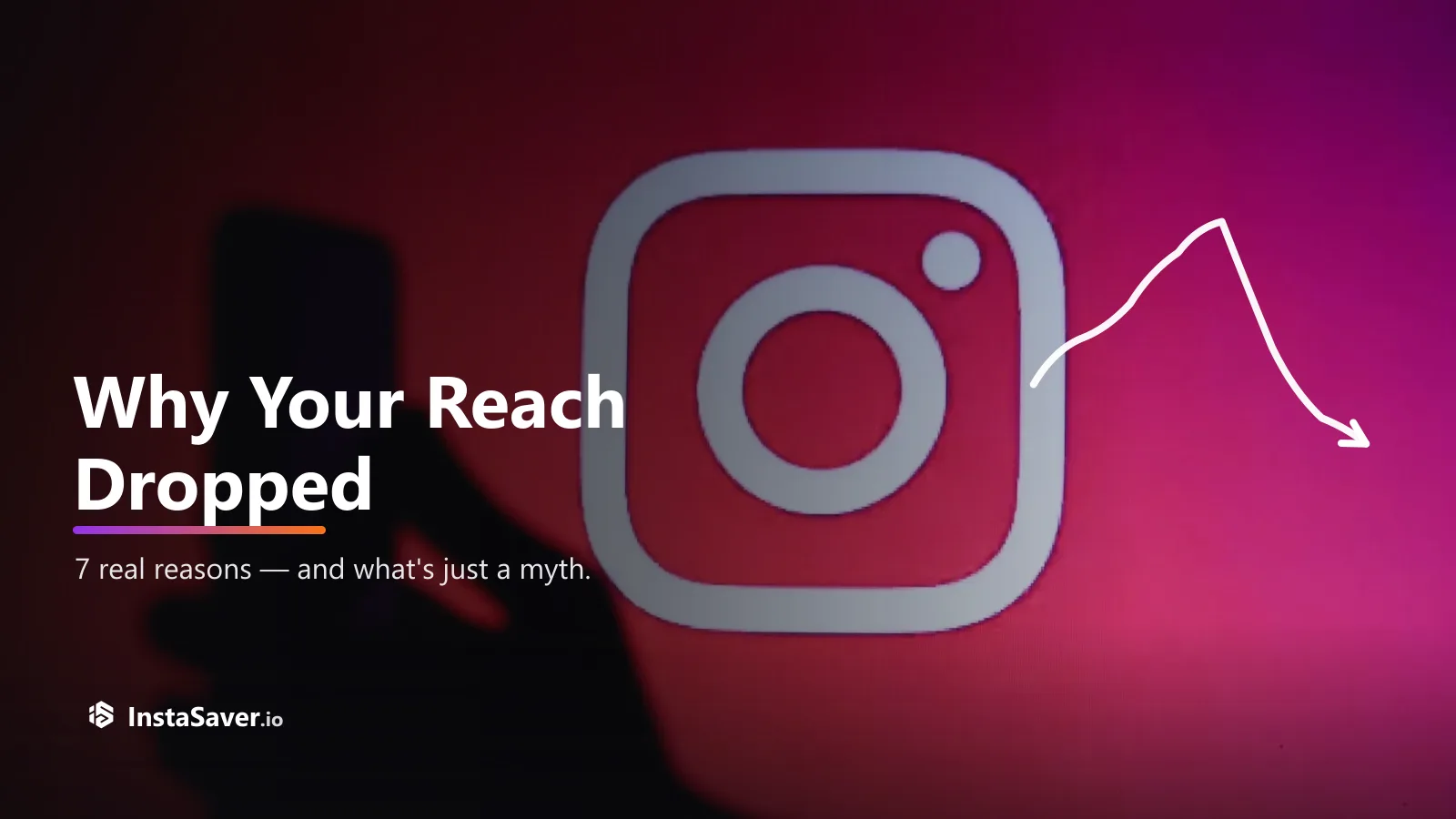
A reach drop feels like a punishment, but it almost never is. Here are the 7 real, fixable reasons — and the myths that just waste your energy.
 Insta Saver TeamMay 28, 20268 min read
Your posts were doing fine, and then the numbers fell off a cliff. It's a horrible feeling, and the internet's first answer is always the scariest one: *you've been shadowbanned.* Almost always, that's not it. Reach drops for a handful of ordinary, fixable reasons — and knowing which one hit you beats panicking every time.
Here are the seven real causes, roughly from most to least common, plus the myths worth ignoring. If you want the bigger picture on how reach is decided in the first place, start with how the Instagram algorithm actually works — this post is about what to do when it suddenly stops working for you.
A genuine drop shows up as a sustained decline across many posts, not one bad day. It usually looks like the climb-then-cliff below: things build, then something changes — your posting rhythm, your format, or the topic — and reach steps down and stays there until you adjust.
Before we get to causes, it helps to reframe what reach even is. Reach isn't a score Instagram assigns you — it's the outcome of thousands of small predictions about whether each person will care about each post. When reach falls, it means those predictions got less confident. Nothing was taken away from you; the signals just changed. That reframe matters, because it turns 'I've been punished' into 'something in my recent posts changed the signal' — which is fixable.
Most drops trace back to one of these. The good news: every one of them is something you can act on.
The most common cause by far. Gaps and erratic timing give the ranking systems fewer recent signals to work with, and momentum fades fast.
Switching from Reels to static posts (or vice versa) moves you to a different ranking surface with different reach. It can look like a "drop" when it's really a format change.
If recent posts lost people in the first seconds, Instagram shows them to fewer new viewers. Retention is the lever — see the reels guide below.
Saves and shares carry more weight than likes. If your content got more "nice" but less "worth keeping," reach softens even with steady likes.
Posting outside what your audience follows you for confuses the interest signal. Reach recovers when you return to your lane.
Holidays, big news, or simply more creators posting the same day can quietly compress everyone's reach for a while.
Rare, but real: reused/watermarked-from-elsewhere content or a community-guideline issue can limit distribution. Instagram now tells you in Account Status (see below).
Open Insights and answer three quick questions about your recent posts versus your good stretch. They point straight at which reason above is yours.
Fewer posts or irregular gaps → reason 1. Rebuild a steady schedule first.
Moved between Reels and static posts → reason 2. You changed surfaces, not "got banned".
Likes steady but saves down → reason 4. Make posts more worth keeping.
Instagram gives you a real answer for the scariest case. Open Settings → Account status (Account Status). If your content or account is actually being limited, it's stated there, in plain language, with what triggered it. If Account Status says everything's fine, you are not shadowbanned — full stop. That rules out the myth in about ten seconds.
These come up every time reach dips. None of them will fix it, and some make things worse.
| The myth | What's actually true (as of 2026) |
|---|---|
| "I've been shadowbanned." | If Account Status shows no limits, you're not. Real limits are disclosed there. A quiet drop is almost always format, timing, or engagement. |
| "Delete and repost — it flopped in the first hour." | Especially for Reels, posts keep getting served for days. Deleting throws away the reach you already earned and resets nothing useful. |
| "Add 30 hashtags to escape the ban." | Hashtags are minor now. Stuffing them doesn't lift a drop; a few relevant ones is plenty. |
| "Post every single day or you're punished." | Consistency helps, but forced daily filler with weak hooks can lower average watch time — which hurts more than a skipped day. |
| "Turn off / on a business account to reset reach." | Account type doesn't carry a secret reach penalty. Switching it changes nothing about ranking. |
You don't need a reset — you need a few steady moves. In order:
One more thing worth saying plainly: a reach drop is not a verdict on your work. Accounts of every size go through flat stretches — a format the audience cooled on, a season with more competition, a run of posts that were fine but not save-worthy. The creators who recover aren't the ones who found a secret reset. They're the ones who calmly read their own data, returned to what worked, and kept showing up while the trend turned back up.
Reach is a signal to improve, not a punishment to undo.
Reach recovers faster when you study posts that land. Insta Saver's free tools let you view and save public Instagram content to learn from — no login, right in your browser.
We build free Instagram tools — an anonymous story viewer plus photo, video, reels, and profile downloaders — and write practical guides on saving, viewing, and understanding Instagram content, without the hype.
More about usInstagram has its own search engine, and since July 2025 Google indexes a slice of public posts too. Here's where your keywords actually matter.
Instagram capped hashtags at five and quietly killed hashtag-follow. Here is what that actually means, and what to use instead for the reach hashtags used to promise.