Instagram SEO: How to Get Found in Search (Not Just the Feed)
Instagram has its own search engine, and since July 2025 Google indexes a slice of public posts too. Here's where your keywords actually matter.
 Insta Saver TeamJuly 13, 20267 min read
Someone lands on your profile with one question: 'why should I follow?' Your bio has about three seconds and 150 characters to answer it. Here's the formula that does.
 Insta Saver TeamJuly 13, 20267 min read
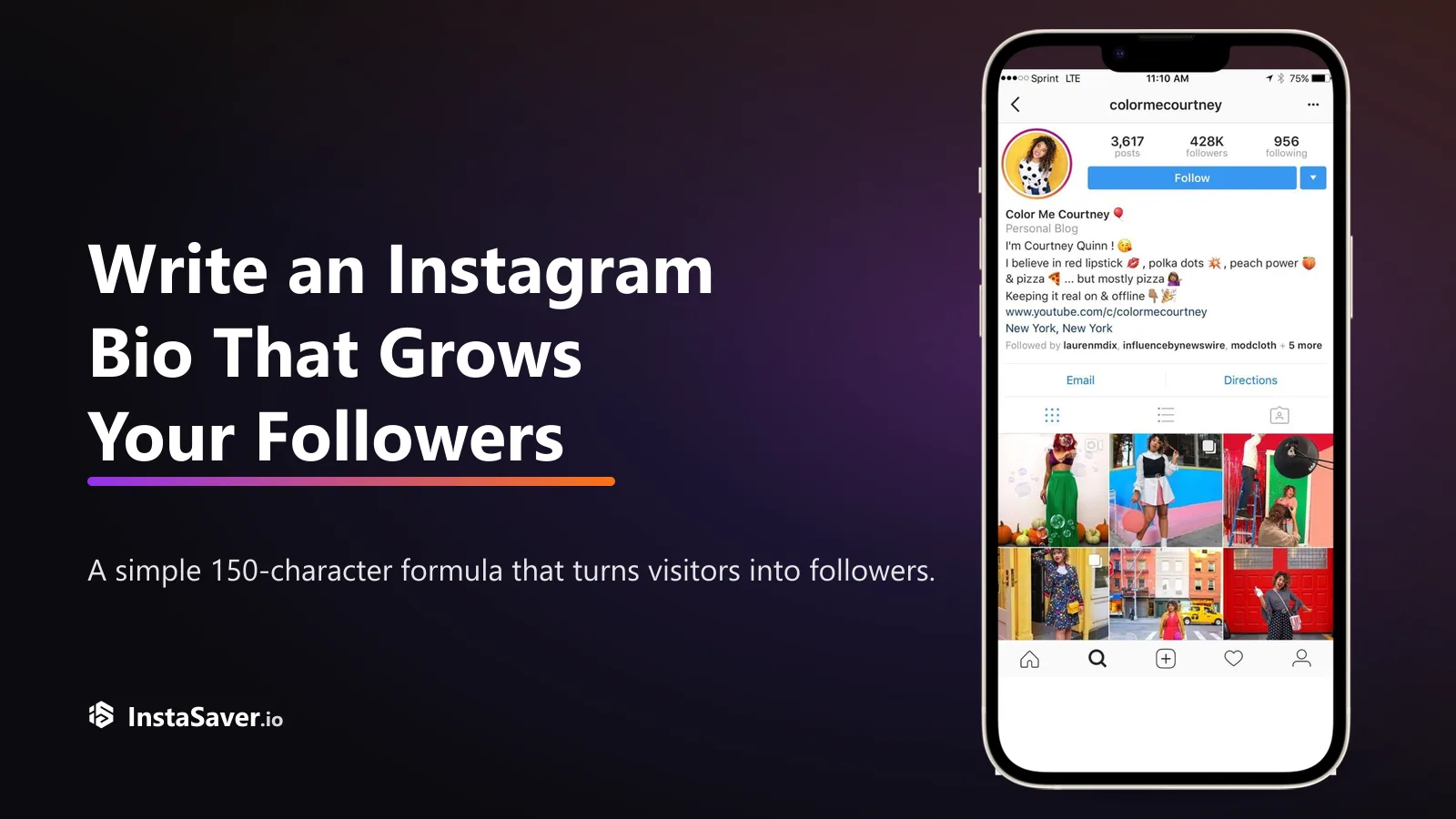
Someone taps your name, lands on your profile, and makes a decision in about three seconds: follow, or keep scrolling. In that moment your bio is doing almost all of the work. It's roughly 150 characters — one line of who you are, one reason to care, and one thing to do next. Most bios waste all three.
The good news is that a bio isn't a creative-writing problem. It's a small, fixable formula. This post walks through exactly what a follow-worthy bio contains, shows real public profiles that get it right, and covers the two tricks most people miss: the link strategy and the searchable name field.
Almost everyone who *chooses* to follow you reads the bio first. They found a reel, tapped through to the profile, and now they're deciding whether you're worth a permanent spot in their feed. That makes the bio the single highest-conversion piece of text you own — it's read at the exact moment someone is deciding.
It also does quiet work you don't see. The name field (the bold line under your photo, separate from your @handle) is searchable, so the words you put there help the right people find you at all. A good bio, then, does two jobs: it convinces the visitor to follow, and it helps new visitors show up in the first place.
Everything after that is cut off. Every word has to earn its place.
How long a visitor spends before they follow or leave. The bio has to land fast.
You can add up to five links to a profile as of 2026 — but one clear one usually does the most work.
Strip away the personality and almost every strong bio answers three questions in order. Who is this for? Why should I believe you? What do you want me to do? Get those three right and the exact wording matters far less than you'd think.
The first line should make the visitor think "that's me" or "I want that." Be specific: "Weeknight dinners for busy parents" beats "Food & lifestyle."
One piece of proof or personality — a credential, a result, a number, or a genuine point of view. Not a wall of adjectives; one true thing.
Tell people exactly what to do: watch the latest video, grab the free guide, shop the link. One call to action, pointed at one link.
The mistake isn't usually a bad line — it's three competing lines. A bio that lists your job, your dog, your zodiac sign, three emojis, and a quote gives the visitor nothing to hold onto. Pick the one identity you want to be known for and cut the rest.
If your account runs on *you* — your voice, your face, your take — the bio should sound like a person, not a brand deck. The point isn't to be clever; it's to make the right people feel like they've found their kind of account. A little personality plus a clear link does the whole job.
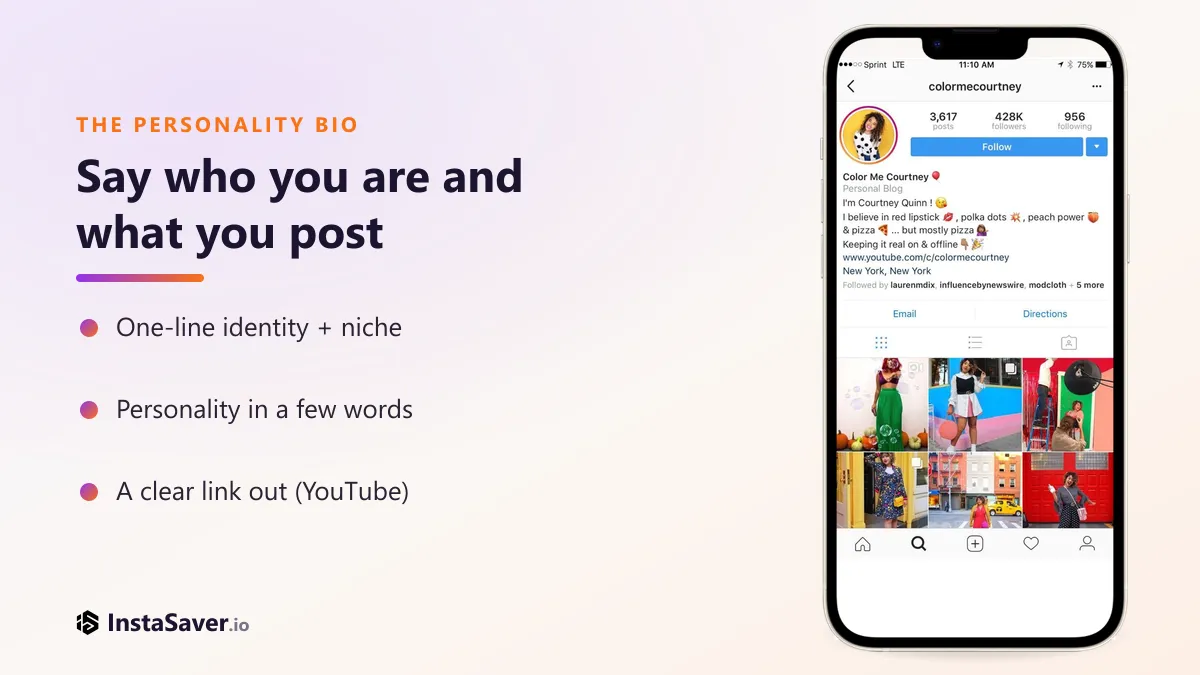
Notice what it does *not* do: it doesn't try to be everything. It names the vibe, shows a bit of character, and sends you somewhere. Personality bios fail when they're all personality and no signal — charm with no answer to "what do you post?" Keep the voice, but keep the promise too.
For a coach, a business, or anyone with a few concrete things to offer, structure beats prose. Put each offer on its own short line so the whole profile is scannable in a glance. This is where line breaks and a single emoji-as-bullet actually help — they turn a paragraph into a menu.
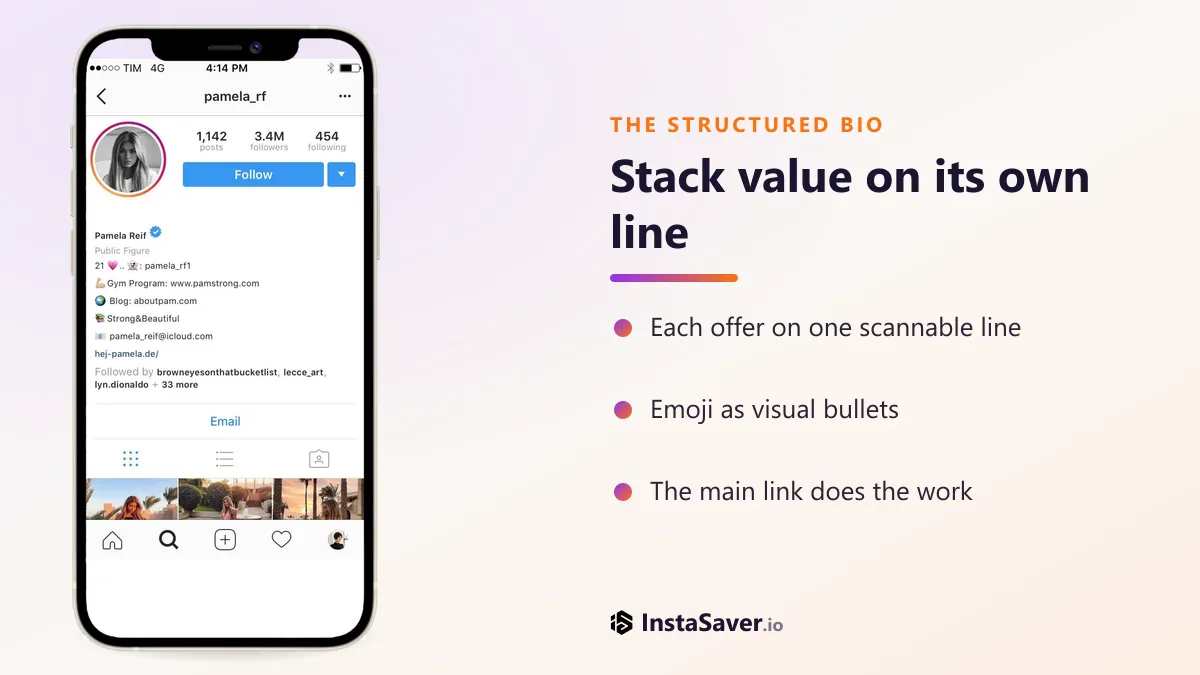
To add line breaks, don't fight the app in the caption box — type your bio in your notes app with the breaks exactly how you want them, then paste it into Edit profile → Bio. Keep it to three or four lines; past that it reads as clutter and the important line gets buried.
Two parts of the profile do outsized work and almost everyone leaves them on default. The first is the link. You can add several links now, but the real win is pointing people somewhere useful — and if you have more than one destination, a simple link tool (a single URL that opens a little menu of your links) keeps the bio clean.
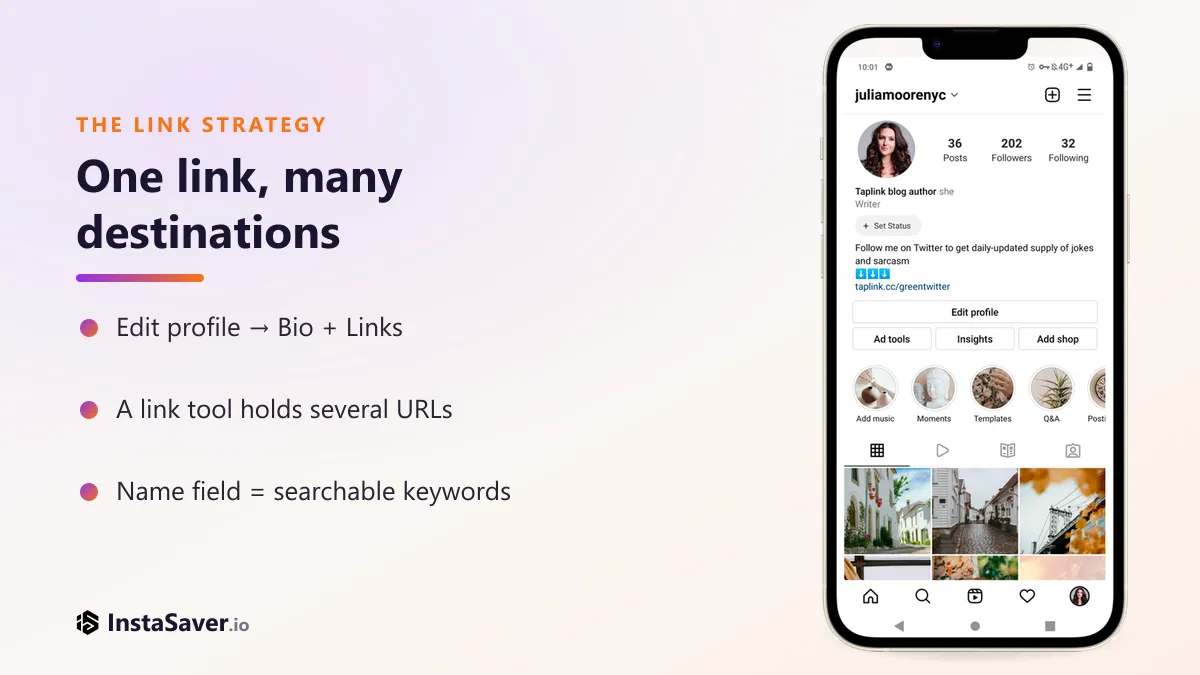
The second, quieter lever is the name field — the bold text under your photo. It's not your @handle, and unlike the handle it can be anything. Instagram treats it as searchable, so putting a keyword there ("Mia · Vegan Recipes" rather than just "Mia") helps you surface when someone searches that term. It's one of the few pure-SEO moves left on a profile.
Formulas are easier to use with a starting point. These aren't meant to be copied word for word — swap in your specifics — but they show the who-help / proof / next-step shape in different niches. Aim to fit the whole thing in about 150 characters.
| Niche | Bio template (who → proof → next step) |
|---|---|
| Coach / educator | “I help [who] do [result] without [pain]. [Proof, e.g. 5 yrs / 10k trained]. Free [resource] 👇” |
| Local business | “[What you make] in [city] 📍 [One proof or specialty]. Order / book below 👇” |
| Creator / personal | “[Name] · [what you post]. [A line of real voice]. New [videos/posts] every [cadence].” |
| Product / shop | “[What it is] for [who]. [One standout: handmade / vegan / ships free]. Shop the link 👇” |
| Portfolio / freelancer | “[Role] for [industry]. [Notable client or result]. DMs open · work below 👇” |
Once your bio is written, run it past this list. Most weak bios fail on the right-hand column, and almost all of those are quick fixes.
| Lead with who you help or what you post | Open with a vague quote or your zodiac sign |
| Put a keyword in the searchable name field | Repeat your @handle in the name field |
| Give one clear call to action | List five things you want people to do |
| Use line breaks / one emoji as a bullet | Wall of emojis with no words between them |
| Point the link somewhere genuinely useful | Leave a dead or default link (or none) |
| Update it when your focus changes | Set it once in 2021 and forget it |
A great bio converts the visitors you already earned — but it can't create them. People arrive because a reel or post reached them and made them curious enough to tap your name. The bio's job starts there: turn that curiosity into a follow. So write the bio well, then feed it a steady stream of content worth tapping through for.
That's the same skill that makes your captions pull people in — see how to write captions that get comments. And if you want the wider view of what actually gets your posts in front of new people in the first place, it's worth understanding how the Instagram algorithm works.
Your content earns the visit. Your bio earns the follow. They're different jobs — do both.
The fastest way to sharpen your own bio is to study public profiles doing well in your space. Insta Saver's free profile viewer lets you look at any public Instagram profile — right in your browser — so you can borrow the structure, not the words.
We build free Instagram tools — an anonymous story viewer plus photo, video, reels, and profile downloaders — and write practical guides on saving, viewing, and understanding Instagram content, without the hype.
More about usInstagram has its own search engine, and since July 2025 Google indexes a slice of public posts too. Here's where your keywords actually matter.
Instagram capped hashtags at five and quietly killed hashtag-follow. Here is what that actually means, and what to use instead for the reach hashtags used to promise.